Clinical AI in India: A Good Algorithm Is Not Good Business
One thought stayed with me after the 3rd IIMA Healthcare Summit 2026 on “Advancing AI in Healthcare”:
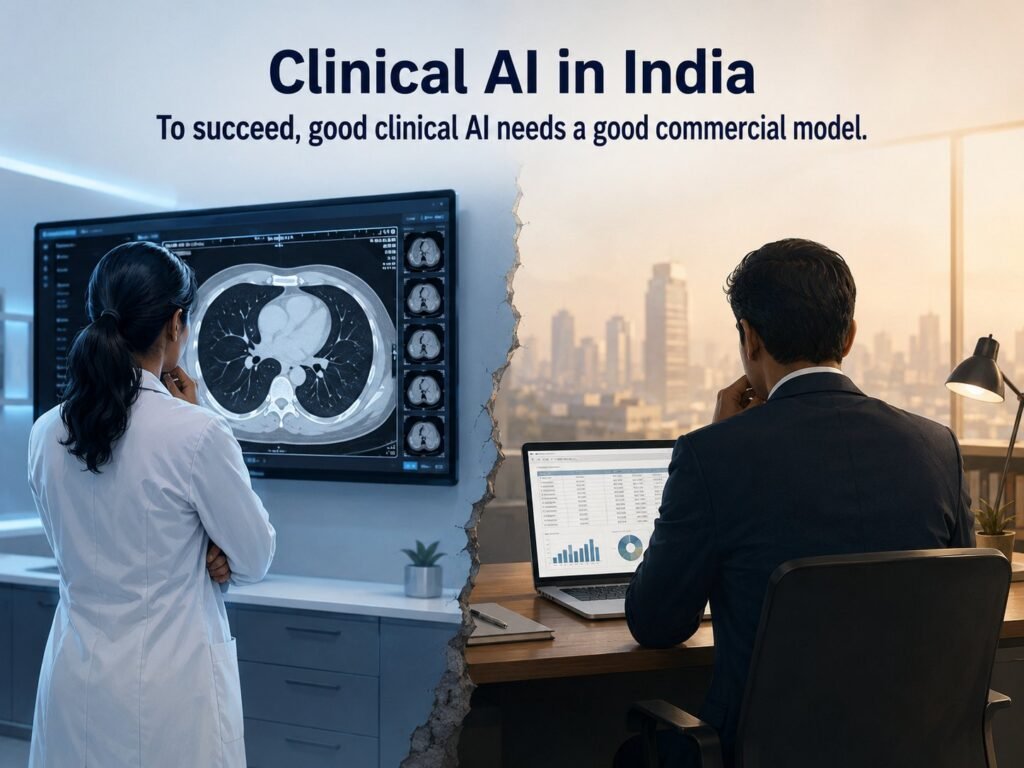
Clinical value and commercial value are not the same thing.
We ask whether clinical AI improves diagnosis, reduces errors or helps doctors make better decisions.
But the business model has to answer another, more important question:
Who will pay for it — and why?
For clinical AI in India, this is particularly difficult.
Healthcare is price-sensitive. But there is a deeper problem: quality, safety and better decision-making are harder to value than something tangible.
Clinicians see this when a patient says:
“I only showed you the report. Do I need to pay?”
The value lies in the doctor’s interpretation and judgment. But without a tangible output, that value is harder to recognise.
The same problem appears in clinical AI.
BUNDLED AI
AI built into a scanner, PACS or hospital system has a major advantage:
The hospital is already buying the product.
The buyer may never need to decide what the AI itself is worth.
The purchase may be driven by price, service, integration, financing and the vendor relationship. The AI is simply another feature included in the package.
For bundled AI, perceived sophistication can sometimes matter more than demonstrated clinical value.
And the clinician may have little ability to reject it. The platform has already been bought; the algorithm comes with it.
Don’t like it? Don’t use it. The purchase has already happened.
STANDALONE CLINICAL AI
Now ask the hospital to buy the algorithm separately.
Everything changes.
The AI itself is being evaluated.
Does it help me?
Can I trust it?
Does it fit my workflow?
Would I actually use it?
The clinician may not control the budget, but has much greater power to reject the product on clinical grounds.
Bundled AI can succeed without convincing every clinical user. Standalone AI usually has to convince both the user and the buyer.
WHAT ACTUALLY GETS BOUGHT IN CLINICAL AI IN INDIA?
A standalone tool may improve diagnosis or reduce errors.
But the hospital still asks:
Does it generate revenue?
Does it increase throughput?
Does it reduce measurable costs?
Can the same workforce manage more patients?
The clinically best algorithm may therefore not be the one that wins.
The winner may be the one that integrates most easily, comes from an existing vendor, creates the least procurement friction — or has the clearest economic case.
The market may reward commercial fit more than clinical superiority.
And this creates the buyer–beneficiary problem.
The patient may benefit.
The doctor may benefit.
The insurer may benefit.
But the hospital writing the cheque may not.
In India, another common argument is also weaker than it first appears:
“We save doctors time.”
In many clinical settings, doctors do not work to a strictly fixed number of hours; they work until the clinical workload is completed.
Saving time therefore does not automatically reduce staffing costs or create an immediate financial return for the hospital.
The economic case becomes stronger when that saved time creates additional capacity — more scans reported, more patients seen, more cases processed, or less need for additional staffing as volumes grow.
Time saved is valuable. But commercially, what matters is what that time can be converted into.
Claims AI → revenue recovered
Workflow AI → greater utilisation
Documentation AI → capacity released
Clinical AI → better decision → better outcome → ???
That missing economic arrow may be one of the biggest barriers to developing sustainable clinical AI.
And the consequences go beyond failed startups.
If clinically useful tools repeatedly fail commercially, developers and investors will move towards easier-to-monetise applications.
Clinical AI risks becoming a commercial no-go zone.
Doctors, however, will still need help with increasingly complex clinical information.
If purpose-built, validated tools are unavailable, they may turn to general-purpose LLMs for complex clinical decisions.
Using general-purpose LLMs for tasks they were not designed or validated for can endanger patients.
Commercial viability of clinical AI is therefore not merely a problem for founders and investors.
It is also a clinical problem.
#ClinicalAI #HealthTechIndia #AIinHealthcare #DigitalHealth